11
Mar
It is used in the production of atp in the electron transport chain. In regards to supplementation, nicotinamide riboside (nr) is widely studied in both preclinical and clinical models.

Difference between nad and nadh. Nad levels decline with age, as well as when the body undergoes metabolic stress, such as upon exposure to a virus. Simply stated, nad is a vital coenzyme naturally produced by the body and found in every single cell. Sirtuins are a family of proteins that are critical to cellular health and functioning.
Nad+ is involved in hundreds of metabolic processes—the most important of which is cellular repair. Generally speaking, when nad is used, nad is being talked about generally. In regards to supplementation, nicotinamide riboside (nr) is widely studied in both preclinical and clinical models.
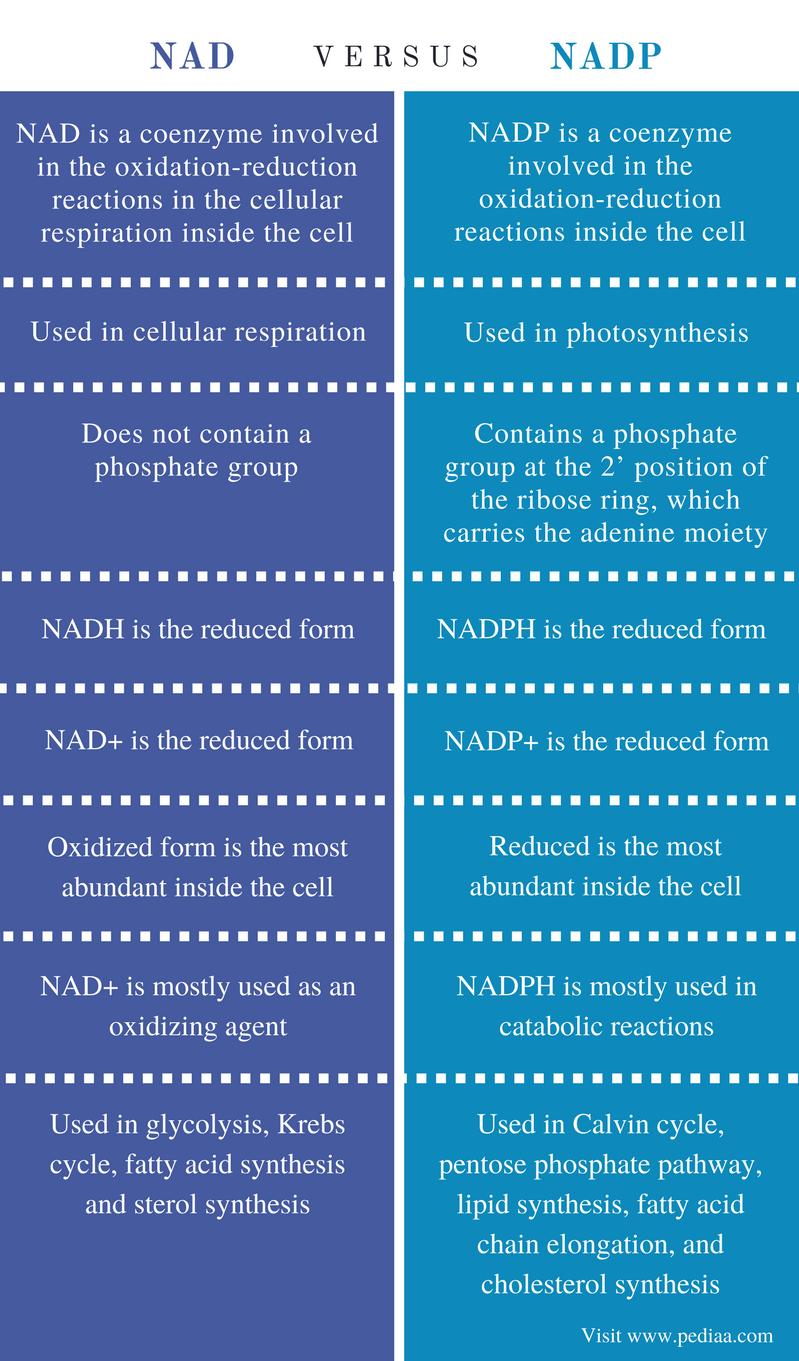
In short, nadh and nadph are reduced forms of nadh + and nadph +, respectively. Nadph is involved in photosynthesis. Nad exists in two forms:
So the nadh to nad ratio and the nad ph to nadp plus ratio are things that are having real consequences as ratios and biochemistry that are dictating what�s going on in our body. What is the difference between nad+ and nadh? It is used in the production of atp in the electron transport chain.
The reduced nadh acts as an electron donor and oxidize to nad + while reducing the other compound involved in the reaction. In the most stable state, nad is positively charged. And often when using “nad” it is referring to the specific chemical forms of nad, nad+ and nadh, interchangeably.
And often when using “nad” it is referring to the specific chemical forms of nad, nad+ and nadh, interchangeably. The main difference between nad+ and nadp+ is that nad + is the oxidized state of nad, which is a coenzyme used in cellular respiration, whereas nadp + is the oxidized state of nadp, which is a coenzyme used in photosynthesis. This is also why people with low nad+ levels tend to burn more easily in the sun.
The main difference between nad and nadh is that nad is the coenzyme whereas nadh is the reduced form of the nad. Nad exists in two forms: Most dehydrogenases use these two forms of nad.
Nad+ is the oxidized form of the nadh. Nad + and nadh are considered molecules, containing the atoms carbon, hydrogen, nitrogen, oxygen, and phosphorous. Generally speaking, when nad is used, nad is being talked about generally.
Nadh is involved in cellular respiration. However, there aren’t equal amounts of nad+ to nadh. Nad+ is in the oxidized form while nadh is in the reduced form.
One of its primary functions is to activate sirtuins. As you probably remember, atoms are the smallest unit of matter and molecules are just a collection of atoms held together by chemical bonds. And often when using “nad” it is referring to the specific chemical forms of nad, nad+ and nadh, interchangeably.
They are two forms of the same coenzyme. The main difference between nad+ and nadp+ is that nad+ is the oxidized state of nad, which is a coenzyme used in cellular respiration, whereas nadp + is the oxidized state of nadp, which is a coenzyme used in photosynthesis. Nad+ enters the cell or organelle (like mitochondria), accepts electrons in the form of hydrogen atoms from nadh (remember it has some extra electrons to donate), and becomes nadh.
While nad+ strongly absorbs mainly the uvb rays, nadh absorbs the uva rays. The short answer is that there is a difference, at least between nad and nadh. Difference between nadh and nadph definition nadh:
The short answer is that there is a difference, at least between nad and nadh. This produces h+ and some electrons, too. What’s the difference between the nadh/nad+ and the nadph/nadh ratios?
However, nad+ is the oxidized form. Nad can protect from skin damage in the sun and skin cancer: The proper reduced $\ce{nad+}$ is $\ce{nadh}$ (it accepts two electrons and one proton), but sometimes $\ce{nadh2}$ is used to account for that second hydrogen that gets removed from the substrate being oxidized.
Generally speaking, when nad is used, nad is being talked about generally. On the other hand, nadph is a reducing agent that has an additional phosphate group than nadh. Nad exists in two forms:
The nad ph to nadh ratio is physiologically irrelevant, but is used as a biomarker. Nicotinamide adenine dinucleotide (nad +) is a coenzyme present in biological systems. For example, nadh is a reduced form of nad+, produced in the krebs cycle and glycolysis.
What is the difference between nad⁺ and nadh? The difference between nad+ and nadh is two electrons and a hydrogen. The key difference between nad + nadh and nadph depends on the form in which they exist.
The overall reaction when oxidizing some molecule $\ce{rh2}$ is: Nadph is the reduced form of nadp. Nadh is the reduced form of nad⁺.
There is a large body of evidence that shows nr is transported directly into cells and nr safely and. What is the difference between nadp+ and nad+? So nad+ and nadh are almost the same thing (with some small differences), like two sides of the same coin.
The oxidized form of the nad is nad + whereas the reduced form is nadh. Nadh is produced in the glycolysis and krebs cycle. Scientists have yet to identify what the optimal ratio is, let alone what the ramifications are when it�s perturbed.
The short answer is that there is a difference, at least between nad and nadh. Meanwhile, the nadh that donated electrons. What is the importance of nadh and fadh2 in cellular respiration?
Nad+, on the other hand, plays a vital role in various biological processes. Nadh mainly functions as transportation for electrons during cellular respiration. Nadp + is the oxidized form of the nadph.
On the other hand, addition of hydrogen ion to nadp + (nicotinamide adenine dinucleotide phosphate), produces nadph. Nad + and nadp + are two oxidized states of coenzymes vital in cellular metabolism. The difference between nad+ and nadh besides several important similarities, nadh and nad+ have some differences too.
A molecule called nad+ has been in the public eye lately. This role of nadh is involved in the processes of glycolysis, tca cycle and in the electron transport chain where nadh is. Nadh is the reduced form of nad.
During the glycolysis and the krebs cycle, nadh molecules are created from nad+, while in the electron transport chain, nad+ is formed from splitting nadh molecules.
Previous post
Difference between pellet grill and smokerNext post
Difference between ms and parkinson s