09
Jul
The stereoscopic or dissecting microscope magnifies objects or specimens that are not allowed to be magnified in a compound microscope, like flowers, coins, rocks, insects, and. If you are looking for one, then you should know that there are two basic types of microscopes, a compound microscope, and a stereo microscope.
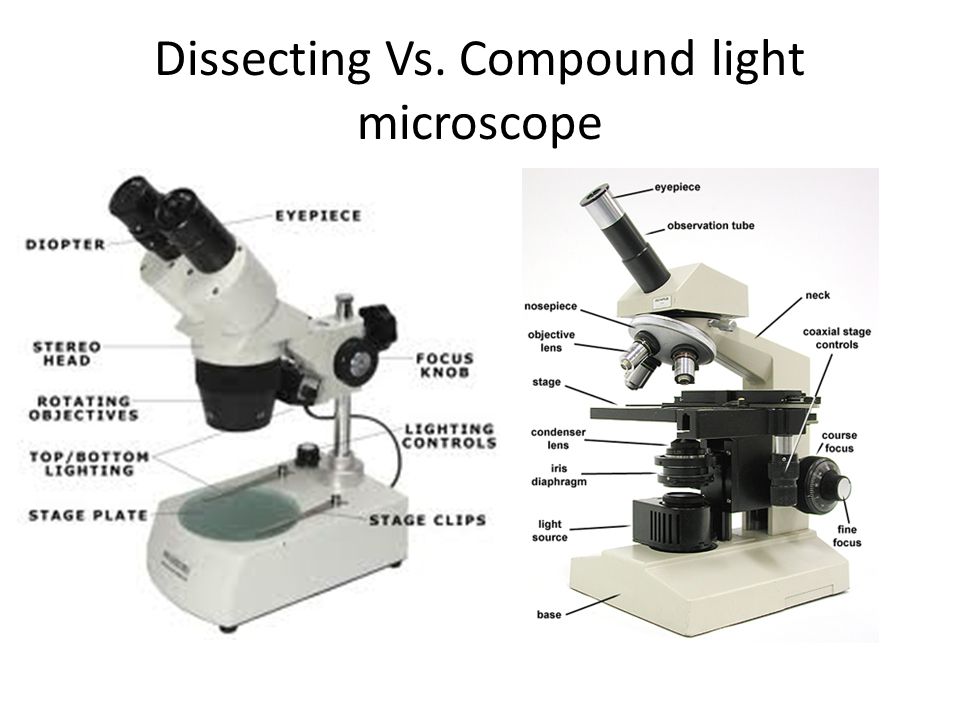
Dissecting microscope vs compound microscope. Dissecting microscopes are useful for observing the surface features of the specimen.on the other hand, a compound microscope is meant for looking through the specimen. Likewise, what types of specimens are used on a dissecting microscope? Dissecting microscopes have low power opticals and illuminators.
The main difference between compound microscope and dissecting microscope is that compound microscope is the microscope that is used to observe small objects with high magnification power, whereas dissecting microscope is used to dissect the specimen. Advertisementcontinue reading belowmain differencethe main difference between compound microscope and dissecting microscope is that compound microscope is the microscope that is used to observe small objects with high magnification power, whereas dissecting microscope is used to dissect the specimen. The main difference between compound microscope and dissecting microscope is that compound microscope is the microscope that is used to observe small objects with high magnification power, whereas dissecting microscope is used to dissect the specimen.
Compound microscope vs dissecting microscope structure. A dissecting microscope has a single objective lens and two eyepiece lenses. Compound microscopes also use transmitted light illumination (light is passed through the sample).
A compound microscope has high magnification power up to 1000x; They have a halogen lamp of 10 watts and fluorescent lighting of 5 watts. On the other hand, the dissecting microscope has a low magnification power of up to 70x.
The microscope allows light to pass through a. Learn vocabulary, terms, and more with flashcards, games, and other study tools. Dissecting and compound light microscopes are both optical microscopes that use visible light to create an image.
However, there are significant differences between the two types of microscopes. Each of the eyepieces’ magnification ranges from about 10x to 40x, and, compared to the compound microscope, a dissecting microscope uses light reflected from the surface rather than through it. Compared to a compound microscope where the objectives attached to the nosepiece can be seen and identified individually (based on color bands and their respective labels), the objectives of a dissecting microscope are located in a cylindrical cone and, therefore, are not directly seen.
Most importantly, dissecting microscopes are for viewing the surface features of a specimen, whereas compound microscopes are designed to. A compound microscope has multiple objective lenses and one eyepiece while a dissecting microscope has a single objective lens and two eyepiece lenses. The compound light microscope can be used with a dye on the slide to view tissue samples, blood, microorganisms in pond water, microscopic cells.
The compound type uses multiple lenses to collect light, and its lenses help to focus the light to the eye of the. Start studying lab quiz 1 (microscopes: As its name suggests, a dissecting or a stereoscopic microscope can play a very useful role in a science class where small creatures need to be visualized closely and clearly, and also need to be dissected for studying their details.
While a lot of people wonder which one is the best, a stereo microscope or a compound microscope. All types of microscopes — dissecting and compound — use a series of lenses to magnify minuscule objects or conduct biological investigations. The stereoscopic or dissecting microscope magnifies objects or specimens that are not allowed to be magnified in a compound microscope, like flowers, coins, rocks, insects, and.
For a compound microscope, the working distance is generally shorter, but also varies with the objective used. Whereas a working distance of 4.0mm is used at 10x, the working distance at 100x is about 0.13mm. This often means that samples have to be dissected into smaller slices to enable the.
The microscope is an incredible gift of science. It usually has two eyepieces for this same reason. They have a rotating head hence the eyepiece can be positioned away and toward the specimen.
It makes you look at this world with a whole new perspective. When you compare the dissecting microscope to compound microscopes, there are some crucial differences. A dissecting microscope has two lens arrays which are aligned in such a manner that they bring about a three dimensional magnification of the object.
In addition to the multiple objective lenses, a compound microscope is usually made with one eyepiece for viewing specimen images whereas dissecting microscopes commonly come with one objective lens accompanied with two eyepiece lenses for better viewing of the specimen while working on it. At the same time, these objects can be slowly moved/manipulated in order to study different parts of interest. However, since it does not allow provide two different axes of the same specimen to be viewed at once it lacks the depth perception and 3d visualization of a dissecting microscope.
Compound and dissecting microscopes are vital pieces of equipment to view objects too small to see with the naked eye. If you are looking for one, then you should know that there are two basic types of microscopes, a compound microscope, and a stereo microscope. Both dissecting and compound light microscopes work by capturing and redirecting light reflected and refracted from a specimen.
Also, a compound microscope has a higher magnification ranging from 400x to up to 1000x while a dissecting microscope can magnify to a maximum of 70x. Most importantly, dissecting microscopes are for viewing the surface features of a specimen, whereas compound microscopes are designed to look through a specimen. How a dissecting microscope is different from a compound microscope?
Previous post
Dissolving viagra in waterNext post
Disney princesses red dress